


Neurodegenerative diseases: the singular role of ITM2B between the retina and the brain
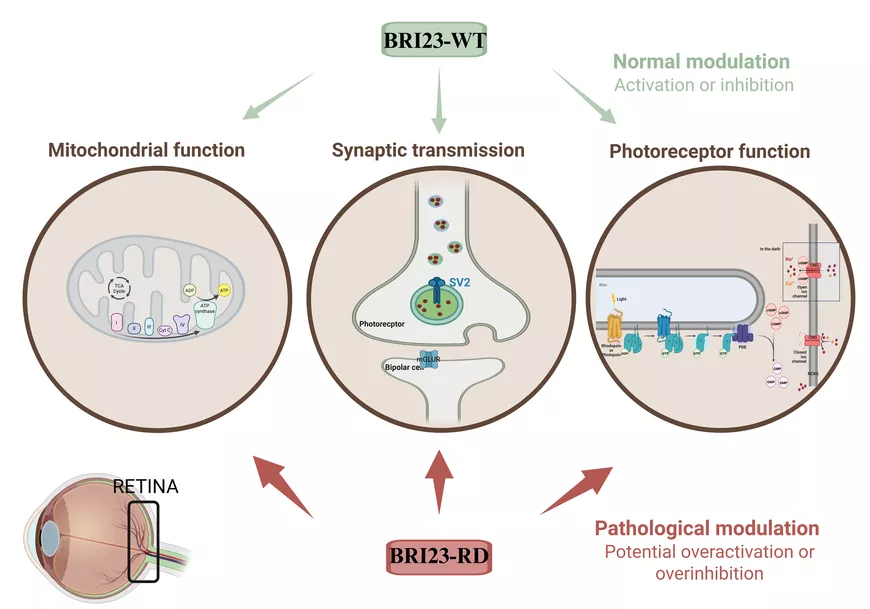
The team of Isabelle Audo and Christina Zeitz has identified a pathogenic variant of the ITM2B protein responsible for a novel form of retinal dystrophy, whereas variants of the protein had previously been associated with Alzheimer-type dementia. Their article [1], which presents the results of Tasnim Ben-Yacoub's PhD thesis, pre-published in Scientific Reports, suggests that the disease progresses through a dysregulation of cellular pathways essential to mitochondrial function and synaptic transmission. By comprehensively mapping for the first time the protein interactions of the BRI23 peptide variant in the retina, the study opens new avenues for understanding neurodegenerative pathologies of the eye.
In 2014, the team of Isabelle Audo and Christina Zeitz (A-Z) identified a family presenting an unusual form of genetic retinal dystrophy [2]. Sequencing of their exome revealed a pathogenic variant in the region encoding the BRI23 peptide of the ITM2B protein, known for its involvement in several forms of familial dementia. In these cases of dementia, ITM2B variants lengthen the BRI23 peptide and trigger the formation of amyloid-like deposits (protein aggregation) in the brain, disrupting cellular activity to the point of causing neurodegeneration.
However, the family studied by the researchers presented no symptoms of dementia. The retinal dystrophy (RD) observed was characterised by dysfunction of the inner layers of the retina, early loss of ganglion cells, accumulation of material in the inner layers and progressive degeneration of the photoreceptors. In these patients, unlike the variants associated with dementia, the ITM2B variant does not lengthen the peptide but replaces an amino acid. Previous modelling studies suggested that the variant could modify ITM2B interactions in retinal tissue, but the exact role of this protein in the retina remained unknown.
PhD student Tasnim Ben-Yacoub and the A-Z team then hypothesised that, since BRI23 is involved in both brain diseases (dementias) and eye diseases (dystrophies), this peptide plays a crucial role in neuronal physiology. To understand how the variant associated with RD disrupts cellular functions, the researchers analysed the interactome of BRI23, i.e. the complete set of proteins that interact with this peptide in the human retina.
To do so, they synthesised normal and RD variant-carrying versions of BRI23. By attaching them to magnetic beads and incubating them in a human retinal protein extract, the researchers identified more than 2,300 BRI23 partner proteins in the retina.
The comparison of the interactomes revealed that the RD variant of BRI23 radically alters protein interactions compared to the normal form. The study suggests that the mutation increases the affinity of BRI23 for numerous protein partners, particularly those linked to mitochondria and synaptic transmission: this gain of interaction would disrupt mitochondrial metabolism essential for the survival of photoreceptors and retinal ganglion cells, and could accelerate their decline, underlying the neurodegeneration observed in ITM2B-related RD.
The work carried out in Tasnim Ben Yacoub's PhD thesis is the first to thoroughly analyse the role of BRI23 in the retina, and of its mutated version in inherited retinal diseases. The A-Z team wishes to continue its investigations on retinal organoids derived from patients with RD, in order to better model the disease and identify potential therapeutic avenues for neurodegenerative diseases of the retina.
[1] Ben-Yacoub, T., Amprou, A., Letellier, C. et al. The ITM2B-associated retinal dystrophy mutation modifies BRI23 peptide interactions in the human retina. Sci Rep (2026). https://doi.org/10.1038/s41598-026-53283-z
[2] Audo I, Bujakowska K, Orhan E, et al. The familial dementia gene revisited: a missense mutation revealed by whole-exome sequencing identifies ITM2B as a candidate gene underlying a novel autosomal dominant retinal dystrophy in a large family. Hum Mol Genet. 2014;23(2):491-501. https://doi.org/10.1093/hmg/ddt439