

Formation
The Institut de la Vision is a conduit for science, whose mission involves training researchers and students, as well as raising public awareness of the challenges of research into vision diseases.
For scientists
— Pr Valentina Emiliani, Institut de la vision
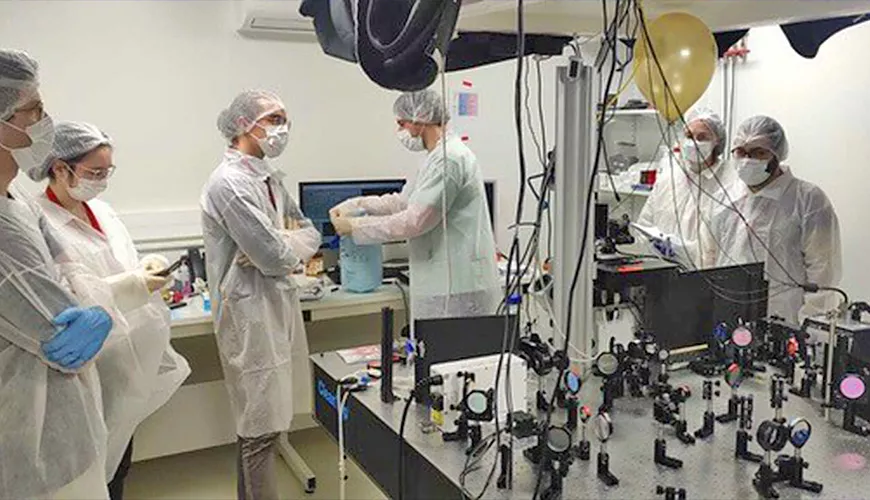
Formation - All-optical Control of Brain Functioning with Optogenetics and Multi-Photon Microscopy
OBJECTIVES
- Learn how to choose the most suitable combination of actuator, illumination methods and targeting strategy for each specific application
- Acquire the skills and technologies required to design and build up an optical system for optical control of neuronal circuits
AUDIENCE
researchers, PhD students or engineers
ORGANISATION
9-18 March 2026 - 8 days, from 09:00 am to 06:00 pm
Training course in English
Institut de la Vision, 17, rue Moreau 75012 Paris, France
TRAINING PROGRAMME
Lectures :
- Introduction to optogenetics
- Wavefront shaping and liquid crystal matrices
- Viral vector design
- Computer generated holography
- Temporal focusing
- Three-dimensional light patterning and temporal focusing
- Two-photon optogenetics: scanning, spiral scanning, parallel illumination: examples
and comparison among the different approaches
- All-optical interrogation of brain circuits
- Voltage and calcium imaging
- 2P Miniscope for two-photon imaging in freely moving mice
- Two-photon all-optical circuits manipulation in freely moving mice
- Patterned voltage and calcium imaging
- Three photon imaging
- Photodamage considerationsPractical courses (in small rotating groups of 5 attendees max with 2 trainers per group)
- How to build up a holographic optical set-up (optical design and software)
- In vitro and in vivo all-optical manipulation of neuronal circuits
- Two-photon all-optical circuits manipulation in freely moving mice
- Two-photon scanless voltage imaging
- Projects from applicants: proposition of projects by the attendees and discussion on their
feasibility
SPEAKERS
Deniz Dalkara (IDV, Paris); Valentina Emiliani (IDV, Paris); Michael Lin (Stanford University, US) ; Dan Oron (Weizmann Institute of Science); Eirini Papagiakoumou (IDV, Paris) ; Emiliano Ronzitti (IDV, Paris); Ruth Sims (IDV, Paris); Francois St Pierre (Baylor College of Medicine); Dimitrii Tanese (IDV, Paris); Johannes Vierock (Charité – Universitätsmedizin Berlin); Claire Wyart (ICM, Paris); Chris Xu (Cornell University, US); Ofer Yizhar (Weizmann Institute of Science); Weijian Zong (Kavli Institute for Systems Neuroscience, Norway)
PEDAGOGICAL METHODS
Lectures (23 h), workshops (28 h) and presentations of projects (8 h). Files in PDF format will be made available to the trainee. Ongoing formative assessments throughout the course. A certificate of completion is issued at the end of the training. Our laboratory is fully accessible for people with reduced mobility (PRM), with dedicated facilities.
TRAINING FEES
2.700 € (including morning welcome coffee, coffee breaks and 2 meals per day)
Registration Details:
People interested to attend the course, should sent a motivation letter and a short CV to Eirini Papagiakoumou (eirini.papagiakoumou@inserm.fr) and Valentina Emiliani (valentina.emiliani@inserm.fr).Selection of candidates will be completed by mid of January.
For students
International Master in Integrative Sensory Neuroscience – iSENSE
The iSENSE Master’s Program (Integrative Sensory Neuroscience) is a high-level Master 2 program dedicated to the study of sensory neuroscience, with a particular focus on vision and hearing. Organized by the Vision Institute, the program is supported by the IHU FOReSIGHT and is built on a strong academic partnership with Sorbonne University, the Pasteur Institute, the Vision Institute, and IHU FOReSIGHT.
This selective master's program, with limited enrolment, offers students in-depth theoretical and practical training in the field of sensory neuroscience. It places particular emphasis on integrative approaches and novel therapies in ophthalmology and sensory neurobiology, while promoting high-quality supervision as well as a wide range of practical work and demonstrations.
AN INTERNATIONAL RESEARCH NETWORK
The iSENSE Master’s Program is supported by a prestigious network of international collaborations, offering students a unique opportunity to engage with leading researchers. Among our academic and scientific partners:
- National Autonomous University of Mexico (UNAM) - www.unam.mx
UNAM is on the largest south american university with more than 250 000 students every year. SU and UNAM are strategic partners, and the iSENSE program is a dual master program. After completing their first year at UNAM, students can then spend their second year at SU and obtain two independent master's degrees, one awarded by UNAM and the other by SU.
- University Pittsburgh Medical Center Vision Institute - www.upmc.com/services/eye
The UPMC Vision Institute in Pittsburgh is a leading research hub focused on advancing treatments for vision loss, with a strong emphasis on ocular diseases, regenerative medicine, and cutting-edge diagnostic technologies. During the Master’s program, students can carry out internships at the UPMC Vision Institute and next have access to PhD funding through our Paris–Pittsburgh doctoral program.
- International Centre for Translational Eye Research (ICTER), Warsaw – www.icter.pl
ICTER is a research and development centre created to develop cutting-edge Hi-Tech to support the diagnosis and treatment of eye diseases, enabling faster implementation of new therapies. Through the EU-funded TRIO-VI CoE project, which unites France, Poland, and the UK, students can participate in exchanges for internships as well as master’s and PhD programs.
AN INNOVATIVE AND INTERDISCIPLINARY CURRICULUM
The iSENSE Master’s Program is designed to offer an interdisciplinary approach combining:
- Sensory neuroscience: exploration of fundamental mechanisms of sensory processing
- Neurophysiology and advanced imaging techniques: functional imaging, electrophysiology, and optogenetics for understanding and manipulating neural circuits.
- Innovative therapies: translational approaches to visual and auditory treatments
WHY JOIN THE iSENSE MASTER'S PROGRAM?
- Access to a world-class research environment: work within the labs of the Vision Institute and its partners
- Mentorship by internationally recognized experts: interact with leading researchers and clinicians in neuroscience and vision science
- International experience: internship and collaboration opportunities with top-tier international laboratories
- Preparation for academic and industry careers: ideal training for pursuing a PhD or entering the biotech sector
APPLICATIONS AND CONTACT INFORMATION
The iSENSE Master’s Program is open to students holding a Master 1 degree in neuroscience, biology, cognitive sciences, or related fields.
Applications must be submitted via the Sorbonne University platform between March 27 and June 12: https://candidatures-2026.sorbonne-universite.fr/
As the program is selective, applicants are encouraged to apply to multiple tracks.
For any questions or additional information, feel free to contact us through: gregory.gauvain@sorbonne-universite.fr and anna.kiseleva@sorbonne-universite.fr
Join us and take part in the future of sensory neuroscience research!
the course programme
STUDENTS FEEDBACK
« It was a high quality program with professors who are true experts in their fields. I’m very pleased to say that my time in research has continued since I finished the masters. Currently I'm working in collaboration with Lariboisière Hospital on a project investigating Neurovascular coupling. I believe that this program should continue not only because it enhances the relation between Mexico and France, but also offers a great opportunity for students from different backgrounds to come together and build enriching research teams. » DANIELA CASTRO FARÍAS
«The Master in Vision Science was one of the best experiences I could have had. I worked in multicultural and multidisciplinary laboratories that allowed me to increase my knowledge and techniques, open my mind to different types of learning, teaching and understanding. I understood that there is no only one way of doing things, but many ways to solve a problem. You just have to listen and learn to work as a team, in addition to being independent to make decisions and move forward. It was a real honor to be part of the first generation. It was a great experience. » YOLOTZIN MARIANA GARCIA
For patients
Patients' University: Patients partners in visual pathologies
Patient University designs and runs a degree course for people with a disease who want to turn their experience of the disease into expertise for the benefit of the community.
Transforming the experience of visually impaired patients into expertise
The training brings together professionals from the Institut de la Vision, the Hôpital national des 15-20, Sorbonne University and the association Comment Dire. It is organized by Streetlab and trains patients who wish to mobilize their experience to engage as team partners in the care pathway of people affected by visual pathologies.
At the end of the training, participants are able to: mobilize their experience to transform it into expertise; better understand and intervene in the care pathway of other patients; use interview tools to understand the needs of other patients and support tools; communicate and work with and within a team caregivers as patient partners; intervening and communicating from a patient perspective with different audiences and institutions.
Course content
- Understanding care pathways, therapies, research and the needs of patients at every stage
- Knowing the history and contributions of patient partners and sharing experiential knowledge
- Develop interpersonal and technical skills as a patient partner within a team
- Practice using tools to support and to collect the needs of patients and tools for tracing their activity as a patient partner
- Meeting with patient partners about their activities within hospital departments or their public interventions.
Pedagogical method
Mini-presentations, work in small groups, practice training, role-playing, etc.
Duration & delivery modality
52-hour training in the form of 3 sessions of 2 days (42 hours) in face-to-face mode and 10 hours of remote micro-teaching via the Zoom application.
Maximum of 12 participants at Streetlab, 13 rue Moreau, 75012 Paris
Information and registration
To find out the next date of the training, please contact Mrs. Cécilia Coen:
Send an email