


Filippo Del Bene, new President of the IZFS
Last month, Filippo Del Bene, team leader at the Institut de la Vision, was elected President of the International Zebrafish Society (IZFS). On this occasion, we invite you to discover his career path, the research he is passionate about and his commitments.
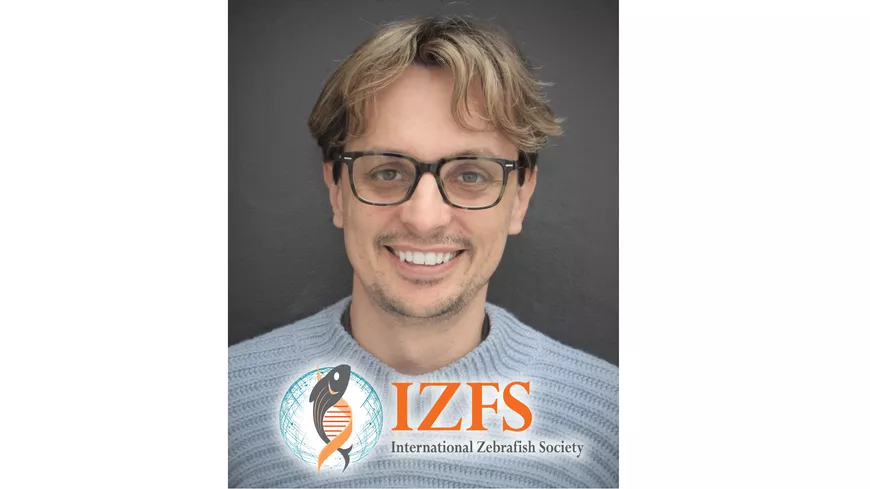
"This nomination is an honour. It reminds me of when I was a young PhD student and found myself at these large conferences where everyone was passionate about zebrafish. Some of the researchers were my heroes and I saw the president of the society as an accomplished scientist. Today I find myself in that position. I am proud to be leading a society with which I have grown" declares an enthusiastic Filippo Del Bene following his election.
The International Zebrafish Society is the largest association bringing together researchers who study zebrafish. Its mission is to unite the community and support young researchers through exchanges and training. It also intervenes when it is necessary to update regulations concerning animal experimentation, encouraging the use of the fish model. "Today, zebrafish is without a doubt the second most used animal model after the mouse," specifies Filippo. "Within our community we use zebrafish as the main model, but there are also other fish species used for their specific advantages." Indeed, zebrafish is a model organism that, in addition to being transparent, is well genetically characterised and, as vertebrate, shares genetic similarities with humans.
"I have always worked on the eye with zebrafish"
After studying industrial biotechnology at the University of Bologna in Italy, Filippo began working with zebrafish and medaka (another small freshwater fish) 26 years ago, during his PhD at the European Molecular Biology Laboratory (EMBL) in Germany. He became interested in their embryonic development, particularly in eye differentiation and the role of the transcription factor Six3 in the formation of the eye field. During his postdoctoral fellowship, he went on to explore the development and function of the visual system in San Franscisco at the University of California (UCSF) in the United States. By studying the neural circuits connected to the eye and vision, he discovered that a group of neurons allowed the fish to distinguish between large and small objects, giving it the ability to focus on small prey while hunting. He then moved to Paris in 2010, where he created his own team at the Institut Curie. "In 2019, as an Inserm Research Director, I joined the Institut de la Vision because I wanted to conduct my research in an environment where neuroscience is the main focus." recalls Filippo.
Understanding the nervous system, from fish to humans
At the Institut de la Vision, Filippo Del Bene seeks to understand how neurons and neuronal circuits function in vertebrates. His team focuses on the mechanisms that maintain neuronal homeostasis from birth to the death of the animal, as well as on how visual information is shaped by neuronal ensembles finally addressing questions such as: how does the fish perceive and interpret the world around it? What is a relevant stimulus for hunting or for escaping a predator? They also work on the differentiation and regulation of retinal stem cells in fish eyes and develop technologies such as CRISPR tools to modify the fish genome. "This is important for our work, but also for projects more oriented towards translational research, where we try to reproduce mutations present in certain human diseases to create precise models of these diseases in fish," explains the researcher. His team collaborates with the institute's genetics department led by Christina Zeitz to investigate candidate genes for certain diseases... "but also with Valentina Emiliani's team for optogenetics and microscopy, as well as with Alain Chédotal's team for the study of commissural neurons and how they regulate the functioning of visual circuits" indicates Filippo.
Among his collaborations with Alain Chédotal, one of them gave rise to one of the results that has marked Filippo the most: they managed to show that the bilateral connection of the eyes to each hemisphere of the brain is not an evolution specific to mammals. Several hundred million years ago, the common ancestor of fish and humans possessed this dual connection, but fish lost it over time, now only displaying completely crossed connections, known as contralateral: the right eye connected only to the left hemisphere and vice versa. "It is truly fascinating because we tend to see evolution as a progressive scale, or even like a Pokémon evolution. We cannot say that humans are more evolved than mice or fish: they have all evolved by adapting to the environment in which they live. Evolution is a branching tree. At a certain point, [humans and fish] had a common ancestor and it is possible to trace back its characteristics based on those that remain in the different branches."
An ambitious and committed president
Elected for three years, Filippo Del Bene will be responsible for approving the society's budget and coordinating the organisation of events. As a personal goal, he wishes to open discussions with other existing zebrafish societies to propose common and coordinated initiatives and to help bringing the zebrafish community together. "Events, conferences and membership fees are multiplying. It is better to have a common stronger voice, it will be beneficial for everyone." This vision for the zebrafish scientific community is in line with his commitment to the dissemination of knowledge in genome editing. Last January, the researcher went to South Africa with Karine Duroure, a research engineer in his team at the Institut de la Vision, to train researchers and students in their genome editing methods. His ambition is to spread the zebrafish model as widely as possible and to develop local research expertise in order to fully exploit its therapeutic potential.