


EGFLAM: discovery of a new gene linked to complete congenital stationary night blindness
A team led by Isabelle Audo and Christina Zeitz at the Institut de la Vision in Paris, in collaboration with clinicians from the Netherlands*, identified mutations in a novel gene which are responsible for a rare ocular disorder called complete congenital stationary night blindness. This discovery, published in early December 2025 in the journal JAMA Ophthalmology*, paves the way for better diagnoses and deepens our knowledge of ocular pathologies in general. The gene in question, called EGFLAM, besides being linked to this inherited retinal disorder, explains and confirms certain mechanisms of myopia development.
The CSNB, a rare disease with genetically unsolved cases
Congenital stationary night blindness (CSNB) is a rare genetic disease of the retina, present from birth, that prevents the eyes from seeing properly in the dark. Patients see little or nothing at night, often showing a high risk of high myopia, alongside other ocular symptoms. Among the known cases of CSNB, researchers at the Vision Institute and others have already identified 20 genes involved in the different forms of CSNB, including 5 leading to complete stationary congenital night blindness (cCSNB) always associated with high myopia. Due to specific clinical examinations necessary to correctly diagnose cCSNB, patients often only get diagnosed with high myopia. In addition, the genetic origin of some patients with cCSNB still remains unknown. The existence of these "unsolved" cases implies a less precise diagnosis and management of patients. This is why, as part of the European MyoTreat program, Christina Zeitz's team, and her PhD student Sanja Boranijasevic, are tasked with studying the genome of unsolved patients with CSNB associated with high myopia, in order to better understand the mechanisms leading to myopia in these cases.
A discovery resulting from a European clinical collaboration
At the origin of this study, two patients from French family of Moroccan origin were assessed by Dr Vasily Smirnov and diagnosed with cCSNB at two reference centres in France**. They have been followed since childhood and underwent extensive ophthalmological examinations by specialists in inherited retinal diseases. Researchers carried out analyses to reveal the genetic cause. First, they checked for mutations in genes known to be involved in inherited retinal diseases. In the absence of results, they proceeded to broader genome-wide sequencing methods which gave information about different potential disease-associated genes. By using bioinformatic tools, the team at the Institut de la Vision narrowed down the potential causal variants. Applying previous knowledge based on literature research enabled them to predict that a variant found in the EGFLAM gene is the one causing the disease. They confirmed this in patients and available family members. In parallel, their collaborators from the Radboud University Medical Centre and Rotterdam Eye Hospital in the Netherlands have identified another case of unsolved cCSNB, harbouring a different mutation in the same gene confirming this finding.
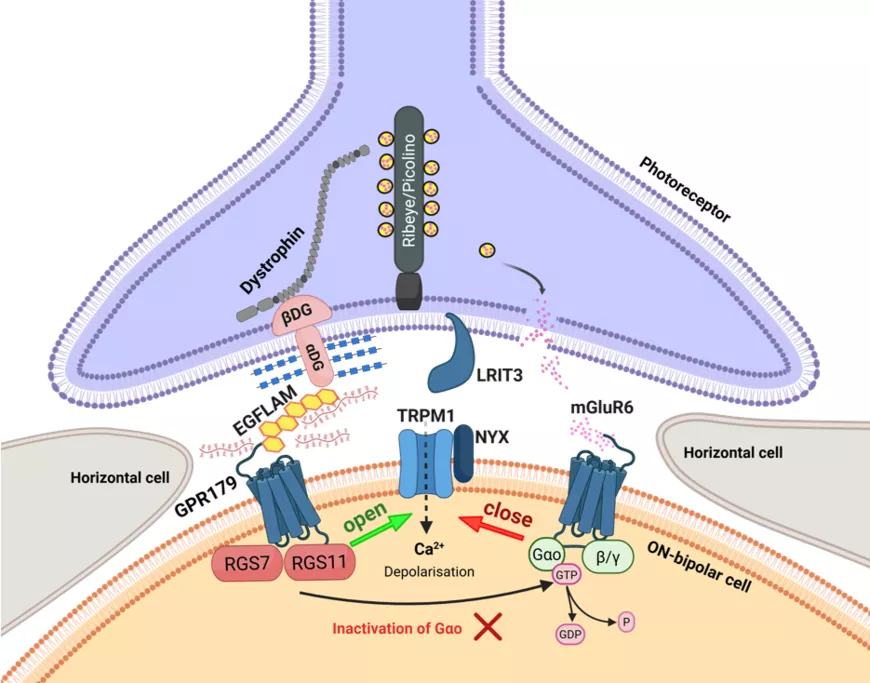
The EGFLAM mutation disrupts the ON-signalling pathway within the bipolar cells of the retina important for retinal signalling. This pathway is essential in the perception of light contrasts on dark backgrounds, the absence of which leads to night blindness and high myopia found in cCSNB.
One more step for research and patients
Thanks to the researchers work, EGFLAM joins the list of 5 genes to be monitored for the diagnosis of cCSNB, probably one of the last given the rarity of variants. For the families concerned, having a name and a precise genetic cause finally allows for appropriate genetic counselling and better ophthalmological monitoring. The discovery of EGLFAM will also help to better understand molecular pathways implicated in myopia, commonly observed in patients with CSNB. Studying the interactions between this protein and others involved in ON-signalling within retina, may provide new therapeutic strategies for myopia, which is the ultimate goal of the MyoTreat program.
Read the full article: https://jamanetwork.com/journals/jamaophthalmology/fullarticle/2842379
* Boranijasevic S*, Smirnov V*, Navarro J, et al. EGFLAM Pathogenic Variants and Congenital Stationary Night Blindness. JAMA Ophthalmol. Published online December 04, 2025. doi:10.1001/jamaophthalmol.2025.4888
**National Reference Centre for Rare Retinal Diseases, Quinze-Vingts Hospital, Paris; Reference Center for Rare Eye Diseases, Vision Exploration and Neuro-Ophthalmology, Lille University Hospital