


Wavefront Engineering Microscopy
The research of the Wavefront Engineering Microscopy group combines technological innovation with fundamental neuroscience questions. On the technological side, the group develops advanced optical methods for stimulating and monitoring neuronal activity (all-optical methos) that integrate single- and multiphoton excitation with spatiotemporal wavefront shaping, holographic illumination, compressed sensing, and probe engineering. On the neuroscientific side, these cutting-edge tools, combined with optogenetic actuators and functional imaging approaches, are used to investigate, with unprecedented precision, functional connectivity and signal processing in neuronal circuits underlying visual perception. In parallel, insights gained from studies of visual circuits and advanced methodological developments are used to guide larger translational research efforts aimed at understanding and ultimately restoring vision in humans.

Presentation
Combined with optogenetic actuators and high-power amplified lasers, these optical strategies enable precise spatiotemporal control of the activity of single or multiple targeted neurons. This allowed manipulation of neural circuits across millimeter-sized volumes, with cellular spatial resolution and millisecond-range temporal precision in the mouse cortex, both in vitro and in vivo. Coupled with calcium imaging, we demonstrated all-optical read/write interfaces for simultaneously monitoring and manipulating neuronal activity, enabling fine-scale functional mapping of neural circuits. By integrating multiphoton holography with endoscopy, the group has demonstrated simultaneous photostimulation and fast functional imaging (up to 80 Hz) at cellular resolution in freely moving mice, targeting both cortical areas and the hippocampus. More recently, the group has shown that holographic light shaping combined with temporal focusing enables high-contrast, high-resolution in vitro and in vivo voltage imaging in densely labeled preparations, including mouse cortex and zebrafish larvae expressing GFP- and rhodopsin-based genetically encoded voltage indicators.
These research efforts are organized around four main domains:
- Large-scale holographic optogenetics and voltage imaging
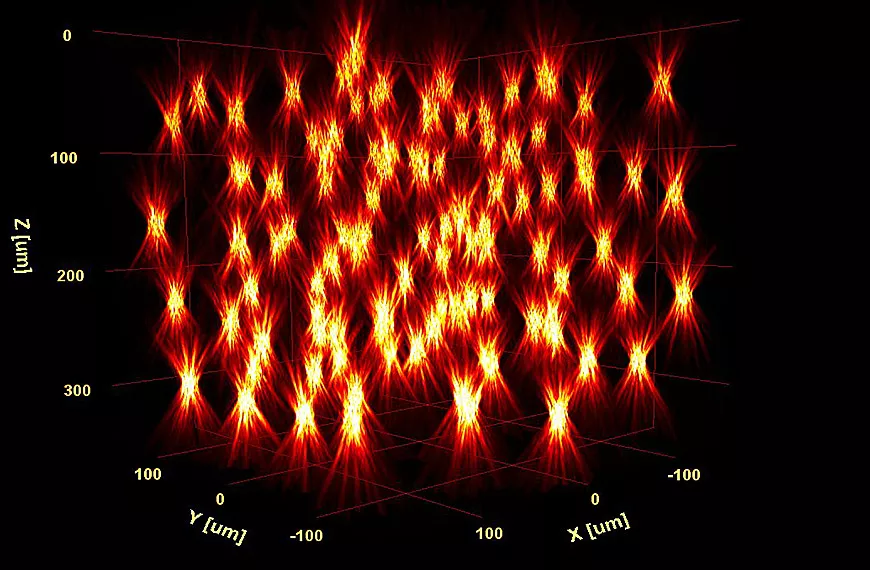
We develop optical strategies for large-scale, two-photon multi-target photostimulation and functional (Ca²⁺ or voltage) imaging. These approaches enable precise, parallel illumination of large neuronal ensembles while maintaining high temporal and spatial resolution. Ultimately, this work aims to enable high-throughput, all-optical large-scale mapping of functional neuronal connectivity across extended and anatomically distributed brain regions in mice. - In-depth all-optical circuit manipulation with three-photon holographic microscopy
We develop advanced three-photon holographic approaches for precise, cell-resolved optical stimulation and functional imaging of neuronal populations deep in living tissue. These methods support new experimental paradigms to probe the organization and dynamics of neural circuits across cortical layers. - All-optical manipulation of retinal circuits
We develop all-optical read–write interfaces for the non-invasive interrogation of retinal circuits across multiple functional layers. These systems enable simultaneous control of retinal inputs to photoreceptors, manipulation of internal retinal processing circuits, and monitoring of neuronal responses at the level of retinal ganglion cells in mouse retina and non-human primate retinal explants. - All-optical manipulation in freely moving animals
We have developed a new class of flexible two-photon microendoscopes (2P-FENDO) that enable near-cellular–resolution imaging and optogenetic control of neuronal activity in cortical layer of freely moving mice providing fast imaging and large fields of view of up to ~500 µm. Recent 2P-FENDO architectures enable in-depth imaging and targeted photostimulation in deep brain regions such as the hippocampus. Together, these instruments provide unique capabilities to monitor and perturb neural circuits in freely behaving animals, opening new avenues for studying the neural basis of behavior in naturalistic relevant conditions.
Research areas
- All-optical manipulation in freely moving animals
- All-optical manipulation of retinal circuits
- Holographic optogenetics and voltage imaging
- In depth all-optical circuits manipulation with 3P holographic microscopy
Team members



















Scientific publications
Below you will find the latest scientific publications in this field: Wavefront Engineering Microscopy.