


Valentina Emiliani, elected Woman Scientist of the Year by the French Academy of Sciences
Head of the photonics department and the Wavefront Modulation team at the Institut de la Vision, Valentina Emiliani (CNRS research director) has revolutionized the exploration of the brain with revolutionary optical approaches that she has been developing for twenty years. By electing her Woman Scientist of the Year on November 25, the French Academy of Sciences underlines the international recognition of her work in neurophotonics, research at the interface between optics and neuroscience.

Just a light pinch
A physicist by training and originally from Rome, Valentina Emiliani began her scientific career by studying the propagation of light in semiconductor quantum structures, making it possible to observe details smaller than the wavelength of light. She moved to Paris in 2002 to initiate interdisciplinary research: using optical tweezers, which trap and manipulate microbeads in a laser beam, in order to mechanically stimulate cells and study their response in detail. This contact with biology led him to create his own team in 2005 called Wavefront Modulation Microscopy, in order to answer a question: how can we shape light to understand, question and ultimately act on the brain's circuits?
Promoted to CNRS Research Director in 2011, she joined the Institut de la Vision in 2018 with her team and took over the management of the new photonics department.
Valentina Emiliani and her interdisciplinary team are now world leaders in the application of modern optics concepts to neuroscience, particularly for the understanding and manipulation of visual circuits. The development of innovative methods is at the heart of Valentina's work: She likes to describe herself as a "sculptor of light" — an image that helps to understand what is behind wavefront modulation.
Sculpting light – Modulating the wavefront
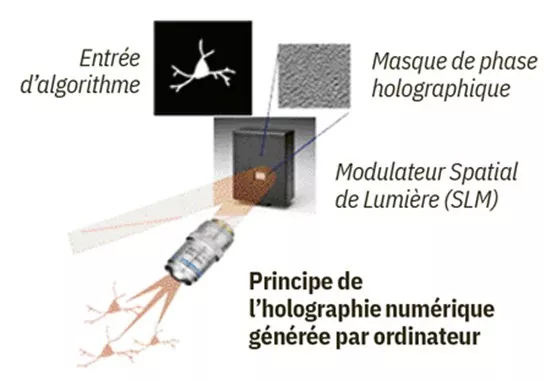
To project complex light patterns inside the brain, Valentina acts in particular on the modulation of the wavefront, i.e. on the control of the shape that light takes during its propagation. To achieve this goal, his team pioneered the use of the time-generated and two-photon excitation Computer-Generated Holography technique. This approach allows the light to be shaped in three dimensions in order to produce, in the neural tissue, the exact map of the volume of the desired light pattern. Thanks to this technology, it becomes possible to selectively illuminate one or more cells in the brain, in real time on experimental models.
These technological advances have opened up a new field of experimentation in neuroscience. Their unrivalled spatial and temporal precision allows us to approach the functioning of the brain from a new angle.
The revolution of circuit optogenetics
Born in the 2000s, optogenetics consists of modifying the genome of certain neurons in such a way as to make them sensitive to light, in order to control their activity in a non-invasive way. This revolutionary technique made it possible for the first time to map brain activity at the cellular type level. But to understand neural circuits in depth, it was necessary to be able to visualize and manipulate their activity with single-cell resolution and on the millisecond time scale. The methods developed by Valentina and her team now reach this level of precision, thanks to the combination of holographic wavefront modulation and optogenetics. This interdisciplinary approach, which she called circuit optogenetics, makes it possible to activate or inhibit individual neurons within a network while simultaneously recording their response, thus paving the way for a detailed understanding of how brain circuits work.
The rise of all-optics to study vision
Since her arrival at the Vision Institute, Valentina Emiliani has continued to develop these tools in order to reach neural circuits located deeper in the brain tissue or to explore larger regions of the visual cortex, for example. She also initiated the development of fiber-optic holography approaches to access the body's neural circuits in free movement, paving the way for the study of brain activity under natural behavioral conditions.
Combined with voltage probes, these approaches now make it possible not only to manipulate neuronal activity with millisecond precision, but also to directly record the electrical signal produced in the brain, right down to the level of the neuron. This double control, entirely optical stimulation and recording, constitutes what is now referred to as an all-optical manipulation of neural circuits. Valentina's team is now focusing on studying the circuits involved in vision, from the retina to the visual cortex. The aim is to understand how vision is reorganized before and after vision loss, but also to design holographic illumination devices that, combined with optogenetic therapies, could lead to advanced visual restoration strategies in humans.
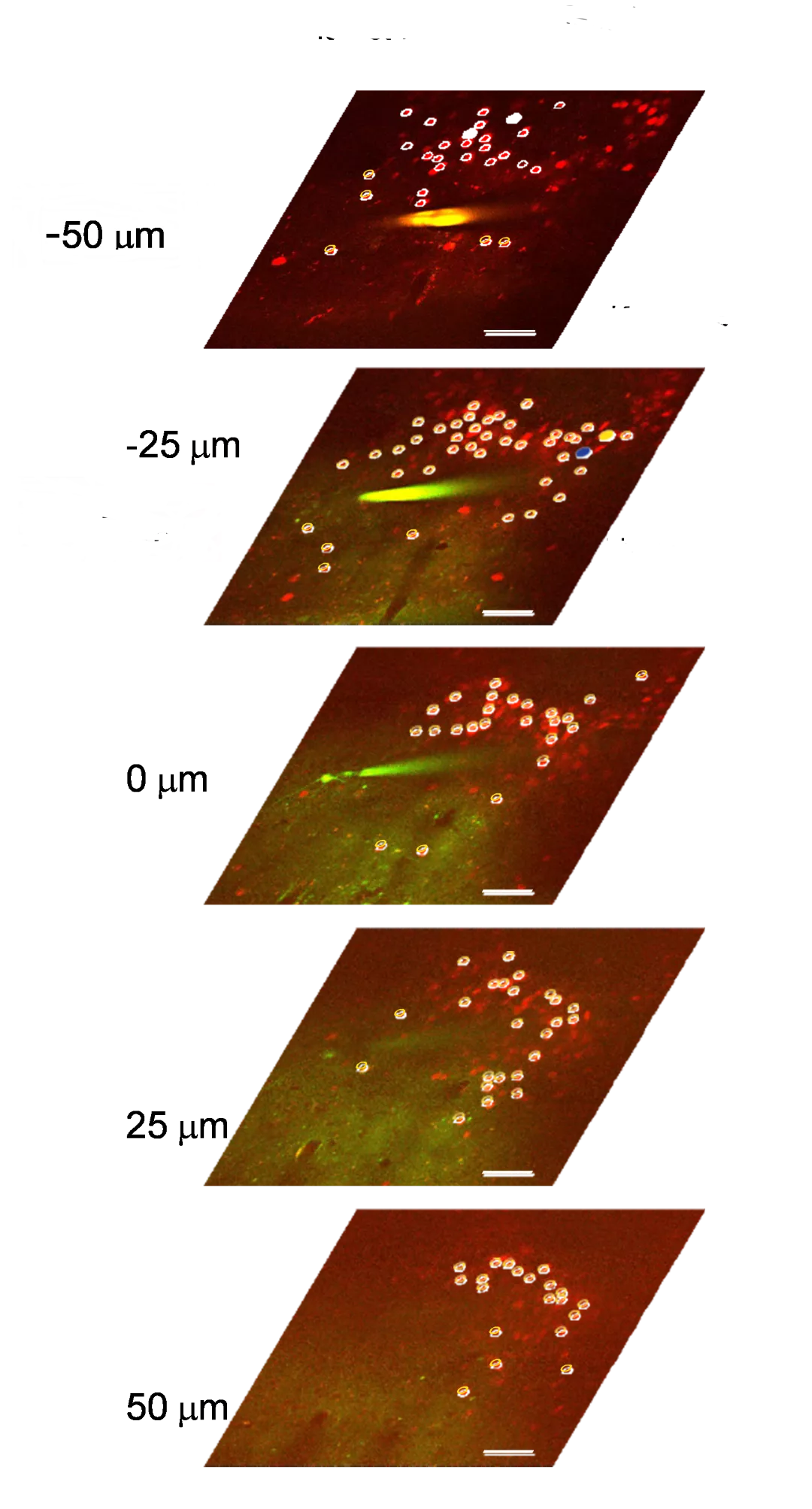
*I-Wen Chen*, Chung Yuen Chan*, Phillip Navarro, Vincent de Sars, Emiliano Ronzitti, Karim Oweiss, Dimitrii Tanese* et Valentina Emiliani*
High-throughput synaptic connectivity mapping using two-photon holographic optogenetics and compressive sensing in vivo
Nature Neuroscience, 2025
https://www.nature.com/articles/s41593-025-02024-y