

Congratulations to the 13 winning projects
IHU FOReSIGHT for Vision is pleased to announce the 13 winning projects selected through its latest call for proposals. Building on the combined excellence of the Institut de la Vision and the Quinze-Vingts National Eye Hospital, these projects address eye diseases for which therapeutic options remain limited, incomplete, or non-existent.The call was designed to foster cross-disciplinary, multi-team projects that bring together expertise, platforms, and resources around major scientific and clinical priorities, thereby strengthening the collective momentum of the IHU.
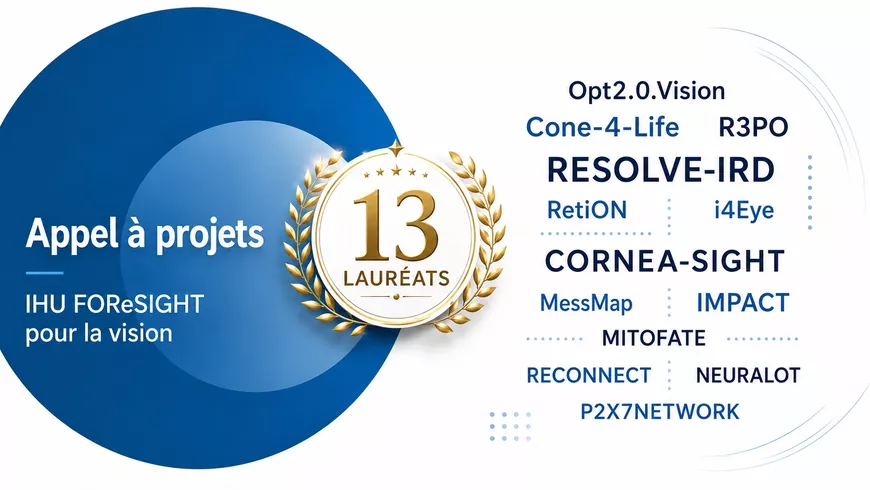
13 structuring projects
By combining basic research, clinical research, and patient care, the selected projects reflect the IHU’s strategic ambition: to better understand the mechanisms underlying visual diseases, develop breakthrough technologies, and open new therapeutic avenues for patients whose medical needs remain unmet.
Aligned with the IHU roadmap and the strategy led by its Director, Prof. Christophe Baudouin, these projects are structured around five major areas: vision protection and restoration; precision imaging and artificial intelligence; aging and inflammation; neuroprotection and neuronal reorganization; and pain and quality of life.
AXIS 1 – Protecting Photoreceptors and Restoring Vision
Many retinal diseases lead to irreversible vision loss. In the absence of curative treatments, the challenge is to protect, repair, or reactivate visual circuits. Thanks to the complementarity between fundamental research and clinical expertise, the IHU is ideally positioned to develop innovative therapies and accelerate their transfer to the clinic.
Opt2.0.Vision
Coordination: Valentina Emiliani (Institut de la Vision)
15-20 National Hospital partner: Isabelle Audo
Institut de la Vision partners: Serge Picaud, Deniz Dalkara, Olivier Marre
This project aims to take optogenetic therapy for patients with retinal degeneration to the next level. By improving cellular targeting, the precision of light stimulation, and the associated devices, Opt2.0.Vision pursues the ambition of gene-independent therapies that could be applicable to a broad range of diseases.
🎥 A video will soon introduce the project’s aims and challenges
Cone-4-Life
Coordination: Serge Picaud (Institut de la Vision)
Cone-4-Life is developing an innovative pharmacological strategy to preserve cone photoreceptors, which are essential for central vision and color vision. The project aims to identify and test neuroprotective combinations in models of retinal detachment and age-related macular degeneration (AMD).
R3PO
Coordination: Olivier Goureau (Institut de la Vision)
R3PO uses retinal organoids derived from pluripotent stem cells to investigate the pathogenic mechanisms associated with mutations in the RHO gene in retinitis pigmentosa. This project represents a key step toward the development of personalized gene therapies.
RESOLVE-IRD
Coordination: Isabelle Audo & Christina Zeitz (Institut de la Vision)
RESOLVE-IRD aims to achieve comprehensive genetic resolution of inherited retinal diseases through genomic sequencing, structural variant analysis, and cellular modeling. By improving our understanding of molecular mechanisms, the project is preparing the ground for the emergence of new targeted therapies.
AXIS 2 – Precision Imaging and Artificial Intelligence
High-resolution imaging and artificial intelligence are transforming the diagnosis and monitoring of visual diseases. By combining biomarkers, clinical data, and computational modeling, the IHU contributes to the development of more predictive and personalized medicine.
RetiON
Coordination: Kate Grieve (Institut de la Vision)
Institut de la Vision partner: Serge Picaud
15-20 National Hospital partner: Christophe Baudouin and Catherine Vignal
The RetiON project combines high-resolution clinical imaging, particularly adaptive optics scanning light ophthalmoscopy (AOSLO), with the development of an innovative multimodal microscope to analyze the cellular and inflammatory mechanisms involved in optic neuropathies. At the interface between in vivo imaging, experimental models, and therapeutic monitoring, this cross-disciplinary project aims to deepen understanding of the cellular and neuroinflammatory processes at work in hereditary and glaucomatous forms of these diseases, using unique, non-invasive, ultra-high-resolution imaging approaches.
🎥 A video will soon introduce the project’s aims and challenges
i4Eye – Models of the Aging Human Macula
Coordination: Michel Paques (Institut de la Vision/ Hôpital National des 15-20)
Institut de la Vision partner: Denis Sheynikhovich
15-20 National Hospital partner: Marie Darche
i4Eye is a cross-disciplinary project that structures an integrated multimodal imaging platform to model macular aging and develop predictive biomarkers. The project is part of the broader dynamic of “digital twins” in ophthalmology.
🎥 A video will soon introduce the project’s aims and challenges
CORNEA-SIGHT
Coordination: Djida Ghoubay (Institut de la Vision)
This project develops corneal organoids combined with innovative imaging tools to model diseases such as Fuchs endothelial dystrophy. It enriches the Institut de la Vision’s translational toolbox by integrating cell biology and advanced imaging.
MessMap
Coordination : Xavier Nicol (Institut de la Vision)
MessMap maps the intracellular signals involved in the development of the visual system. This detailed understanding of signaling mechanisms opens the way to innovative subcellular therapeutic targets.
AXIS 3 – Aging and Inflammation
Aging is a major risk factor for eye diseases. Deciphering the associated inflammatory, immune, and metabolic mechanisms is a strategic lever for preventing vision loss and identifying new therapeutic targets
IMPACT
Coordination: Florian Sennlaub (Institut de la Vision)
IMPACT performs in-depth immunological phenotyping of dry AMD, combining transcriptomics, spatial proteomics, and advanced cellular analyses. The project aims to identify new inflammatory mechanisms and potential therapeutic targets.
MITOFATE
Coordination: Shahad Albadri (Institut de la Vision)
MITOFATE explore le rôle de la dynamique mitochondriale et des espèces réactives de l’oxygène dans la différenciation des cellules souches rétiniennes. Ce projet éclaire les mécanismes fondamentaux du développement et du vieillissement tissulaire.
AXIS 4 – Neuroprotection and Neuronal Reorganization
Vision loss involves not only the retina, but also neural circuits and their capacity to reorganize. Understanding and promoting cellular regeneration and brain plasticity is a key challenge in restoring useful visual function.
RECONNECT
Coordination : Coralie Fassier (Institut de la Vision)
Co-coordination : Stéphane Mélik-Parsadaniantz (Institut de la Vision)
15-20 National Hospital partner: Xavier Guillonneau, Gael Orieux
RECONNECT tackles a major challenge in glaucoma and optic nerve damage: restoring functional connections with the brain. This cross-disciplinary project develops strategies that combine cytoskeletal modulation and inflammation control to promote the survival and regeneration of retinal ganglion cells, as well as the guided regrowth of their axons in cases of optic nerve atrophy or degeneration.
NEURALOT
Coordination : Quentin Gaucher (Institut de la Vision)
NEURALOT studies cortical plasticity after retinal injury using innovative optophysiology tools. The project will provide a better understanding of brain reorganization following vision loss.
AXIS 5 – Pain and Quality of Life
Some eye diseases cause severe chronic pain that is still insufficiently understood and treated. By exploring the underlying neuroimmune mechanisms, the IHU is developing an emerging strategic area dedicated to improving patients’ quality of life.
P2X7NETWORK
Coordination: Annabelle Réaux-Le Goazigo (Institut de la Vision)
This project explores the role of the P2X7 receptor in neuropathic corneal pain by analyzing brain networks, inflammatory mechanisms, and sex-related differences. It aims to identify new therapeutic targets.
A Call for Projects Focused on Diseases with No Therapeutic Solution
The winning projects illustrate the full innovation continuum led by IHU FOReSIGHT for Vision, from fundamental questions on cellular and molecular mechanisms to preclinical modeling and the development of new therapeutic approaches. Together, they aim to address the urgent needs of patients living with visual diseases for which no effective treatment is currently available.
They also demonstrate the strength of a collaborative approach that integrates basic research, clinical expertise, and cutting-edge technologies at the heart of the ambitions shared by the Institut de la Vision and the 15-20 National Hospital.
“When clinical questions meet the answers provided by basic research, we create the conditions for genuine therapeutic breakthroughs. Congratulations to the laureates. These projects demonstrate the strength of our alliance between the Institut de la Vision and the Quinze-Vingts National Eye Hospital, serving patients and addressing the major priorities in vision research.” Prof. Christophe Baudouin, Director of IHU FOReSIGHT for Vision